





Eye For Film >> Movies >> Aanikoobijigan (2026) Film Review



Adam Khalil and Zack Khalil’s Aanikoobijigan, which won the Best Documentary award at ImagineNative 2026, has recently received an English language title: Ancestor. This is a little misleading, however, in a way that gets to the heart of what the film is about. ‘Ancestor’, or ‘great-grandparent’, is only half of the meaning of the Potowatomi word. It also means ‘descendent’, or ‘great-grandchild’. Understanding this term, and its intersectional implications, will enable you to grasp the greater horror under discussion in what is, at its most superficial, a film about grave robbing.
Thomas Jefferson was the first grave robber in North America, we are told, and it seems reasonable to accept that he was the first whose actions were widely known about. We see him in sepia-tinted monochrome, posing with a spade beside a burial mound. His pose is that of an adventurer, not a thief, and it doubtless inspired many of those who followed in his footsteps. They were looking for treasure, for ancient artefacts, and also for human remains. These have since been distributed around museums all over the world. Over two centuries later, many are still there, far from home. One participant in this documentary refers to them as hostages.

This is not the first documentary to explore the issue of colonial looting, but its unique angle makes it stand out. It focuses on the Anishinaabe notion of time not as a straight line but as a spiral, which brings past and future events into proximity with the present, emphasising connections across time. In this understanding, widely shared across the Great Lakes region, the present is in constant conversation with the past and future. Furthermore, when members of these tribes pass on, the molecules making up their bodies go back into the natural world, into the soil and trees, into the food which sustains the tribe. physically and spiritually, they remain a part of it. To take their remains is thus to steal a living part of the tribe, and to detain the spirits of the ancestors, a direct form of ongoing colonial oppression.
“We didn’t have death till America came here,” another participant explains.
Why take the bodies, the bones? Here the documentary explains the particular racist beliefs of the period – the notion that white people were superior to others, and that indigenous Americans were not fully human at all. A reflection on the exhibition of different indigenous people at world fairs, like zoo animals, provides context for this, but in seeking to justify it, it became essential to study the anatomy of different groups, to try thereby to find some kind of proof. There is a look at the wider science of archaeology and the various arguments made, into the modern age, for unearthing and examining the long dead. The scientists don’t get much sympathy, though one might reasonably argue that they’ve had a surfeit of platforms for their views.
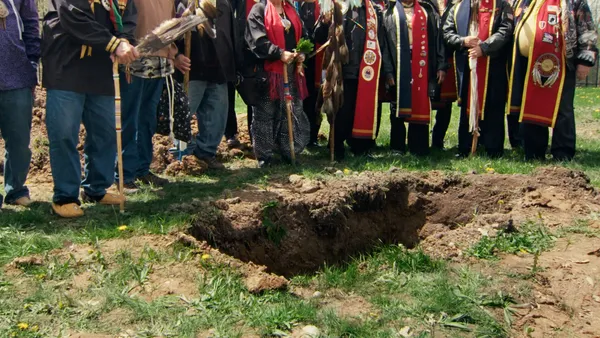
There’s a distinct absence of moderate scientific voices here, until we come to the issue of restoration, at which point we see the delight of those working with indigenous peoples to identify the genealogy of particulr sets of remains. Historically, laws allowing them to be reclaimed only by people ftom the same tribe, after they have been mixed up and mislabled over decades, have effectively made this impossible. Now, the additional knowledge also makes it possible for them to be given funeral rights akin to those they might have recognised in their own time.
How do white people process all this? Some participants express their curiosity. We are presented with a short montage of scenes from films centred on the spiritual threat of old Indian burial grounds. Is this a manifestation of anxiety and guilt? Even for those who never intentionally caused harm themselves, the stain of past genocides won’t go away. To return the remains as people is to acknowledge that they belong in the land, and that the land belonged to them. It is a reminder of the proximity of that history and its continued impacts in the present. For their descendents, meanwhile, reburial is a means of finally setting them free.
Reviewed on: 07 Jun 2026


